From Template to Tabletop
By Jonah “FourM”
In my previous article, I described the way I design frameworks as part of my deckbuilding process. Here, I’ll go into the process of filling that framework with cards, then revise and hone the final product to a razor’s edge.
Step 4: Choose your cards (Private)
This is the easiest step, and you’ve probably had a few cards in mind since the start. But that doesn’t mean there aren’t hard choices to make. Knowing your gameplan is crucial to choosing the pieces which fit your deck the best.
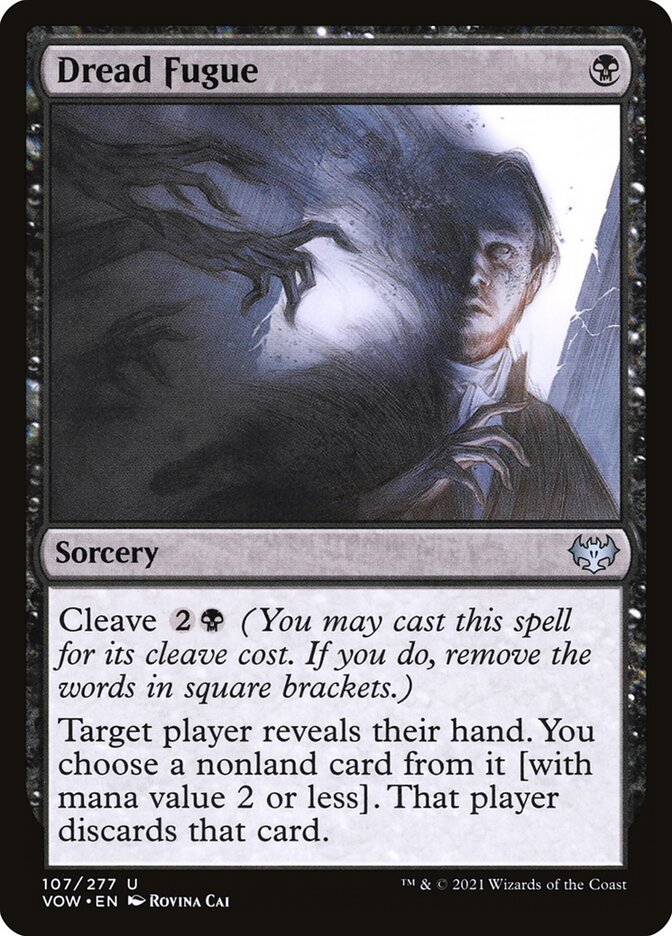
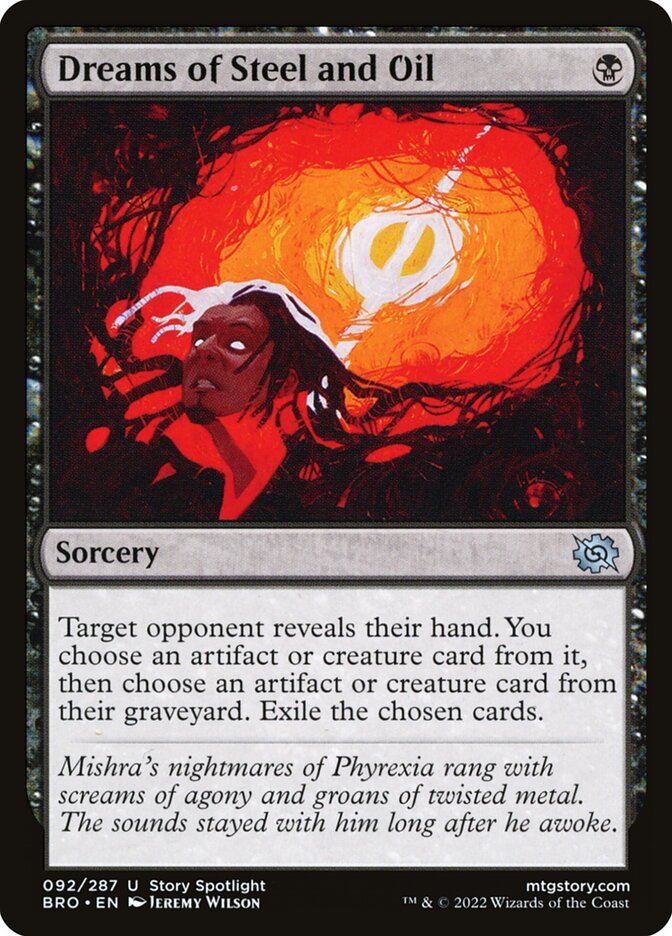
The first hard choice is, of course, choosing between similar effects. Let’s say your deck needs one more hand disruption spell, and you’re choosing between Duress, Dread Fugue, and Dreams of Steel and Oil. This slot will fill a different role in different decks! Duress is often better at protecting your deck against interaction, while Dreams will snipe pesky graveyard threats, and Dread Fugue can hit a number of important early plays.

The other conundrum is with flexible cards. Magic’s main resources are mana, cards, and deck space, so cards which are less efficient when played can still be saving you resources in deckbuilding. The best of these can fill both roles at once, but being able to do one or the other at an efficient rate is also powerful. Keep in mind that if a card fills two roles you’ll need together (like a tutor), it’s still only one card in your deck, so it won’t increase your density for calculating draw odds.
You might find you need to tweak your framework a bit here, and that’s ok, as long as you preserve the key features. Once you’ve filled it out, you’ll have your first draft – Private. It won’t necessarily be a masterpiece, but it’s a strong starting point to feel out the deck’s strengths and weaknesses.
Step 5: Play, Lose, Repeat
Having a deck is one thing but winning games is another. You’ll need to identify and address your deck’s weaknesses before it becomes a true force to be reckoned with. Start by playing some games, seeing what works, and identifying key moments in games you win and lose. Find the discrepancies – what happens when you win which doesn’t happen when you lose, and vice versa. I break down losses into three types:
- Losing to yourself; not getting all the pieces you need to progress your gameplan
- Losing to disruption; your opponent interacts with a key piece and you’re unable to recover
- Losing to aggression; taking too long to get your pieces together or failing to disrupt or defend against your opponent
Identifying your main loss condition this way will guide you towards the best way to address it:
- Losing to yourself is an issue of consistency. Revisit your Kowalski, and see if there’s any way you can get your pieces to work better together or get the right pieces more often
- Losing to disruption is an issue of resilience. Depending on the specifics, you can improve resilience by adding counter-disruption, increasing redundancy, or diversifying your gameplan.
- Losing to aggression is typically an issue in the early gameplan. You might need to adjust your first few turns to account for fast creature or combo decks, either adding interaction or speeding up your own clock to outpace them.

But don’t make any changes yet! Make sure you’ve found the best place to make the change so it has the most impact. It’s also worth considering if it’s worth addressing a vulnerability at all, or if you’re better off sacrificing certain matchups to improve your strength against more popular archetypes. After all, it’s not worth spending your slots to improve a matchup you’ll never face, no matter how many times you lose to your best mate’s Homarid deck.
Card selection is the obvious first choice for improvements. If a card is underperforming, especially in popular matchups, swapping it out for something more suitable is an easy fix. It’s also the best way to improve your consistency.
If your mainboard is solid, consider fixing the problem in the sideboard instead. A lot of matchups can be made much more favourable by silver bullets. But you only have so many slots, so carefully consider how many of them are worth spending on each matchup. You might need to complement a maindeck adjustment with a sideboard suite to swing certain matches in your favour.
If that’s not enough, revisit your gameplan. If the meta has a natural predator, or you need a certain effect but there’s not enough density in the card pool, your strategy might be inherently flawed. This is the hardest to fix, but not impossible. You’ll have to think about other ways to reach your win condition or leverage your most powerful cards.
As long as your strategy still has legs, you can revisit your structure. You might find you’ve undervalued or overvalued certain card types, or one might struggle against a particular matchup. Think about what you can compromise to rebalance your structure in a way which preserves your winning sequences.
The ultimate goal of this step is not to make your deck win every matchup, every time. You should try to focus on winning the matchups you expect to play, which usually means picking your battles. Some matchups will be hard no matter how you prepare for them, but revision will tell you what you’ll need to beat even the most difficult opponents. Which leads me to…
Step 6: Magic: the Gathering
The best way to improve, of course, is to play Magic. Try not to change a card unless you’ve drawn it in a few games. Even though you built the deck, you’ll have to play it over and over to truly learn all the ins and outs. Playing stronger opponents will show you how people can play around your deck’s strengths, and expose weaknesses you didn’t even consider. Playing is actually the most important part of brewing!
So go forth, and bring your creation with you – I can lead you no further. Have ideas, believe in them, and create something nobody expected; this is the power of a brewer. Good luck, have fun, and may the best wizard win!

Jonah “FourM” has been playing MtG since the Khans of Tarkir block. Currently, he enjoys drafting, stomping opponents in Commander and brewing 1-2 decks a week. He’s also working on improving his skillset to make his mark on the RC circuit.
He’s also making weekly videos about his experiences playing 7PH. Check them out here!
